Title & bullets
The title and bullets sections are where most listing wins hide. This page walks through what each one measures, how the sub-scores work, and how to read the suggested rewrites.
Title
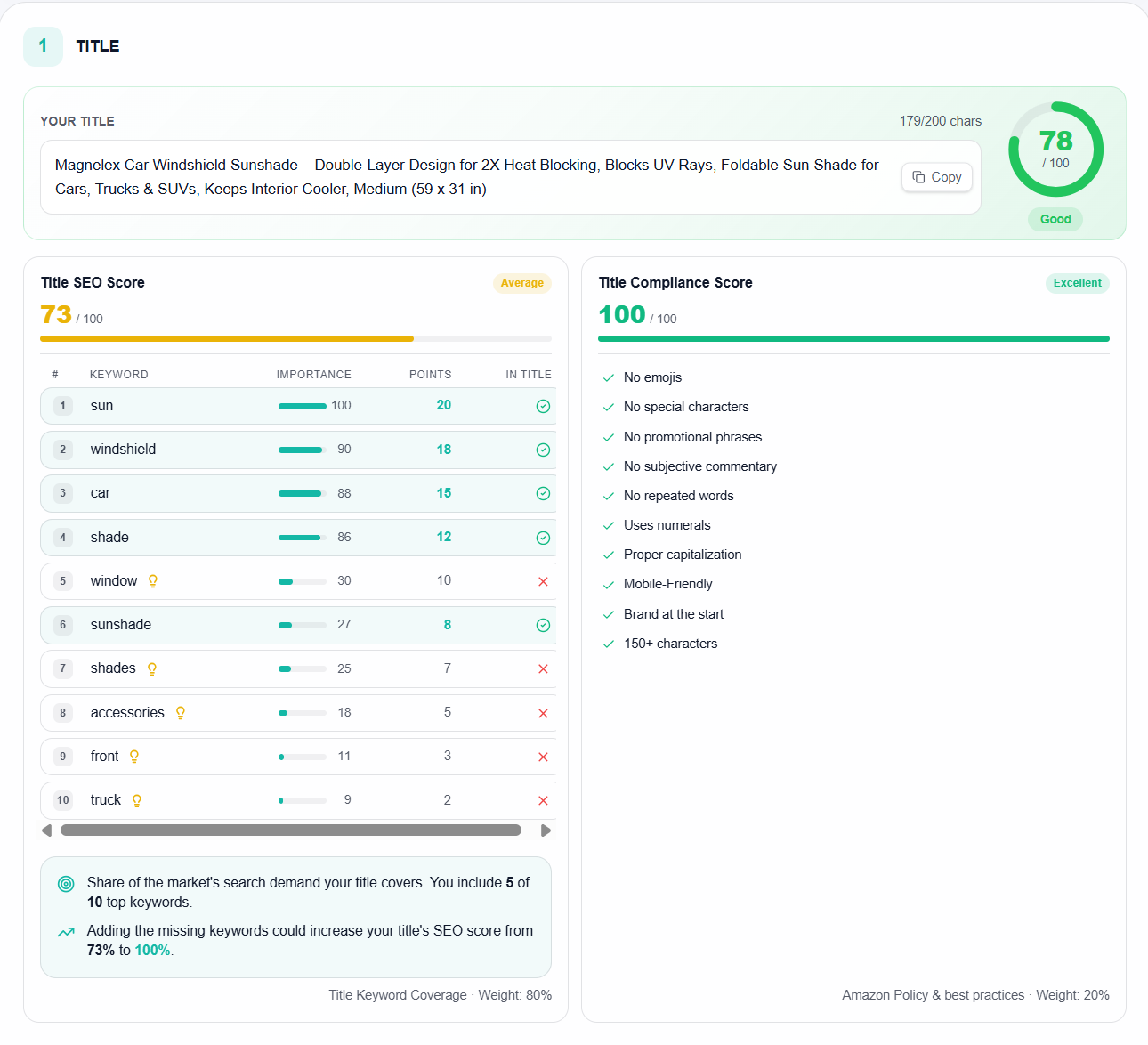
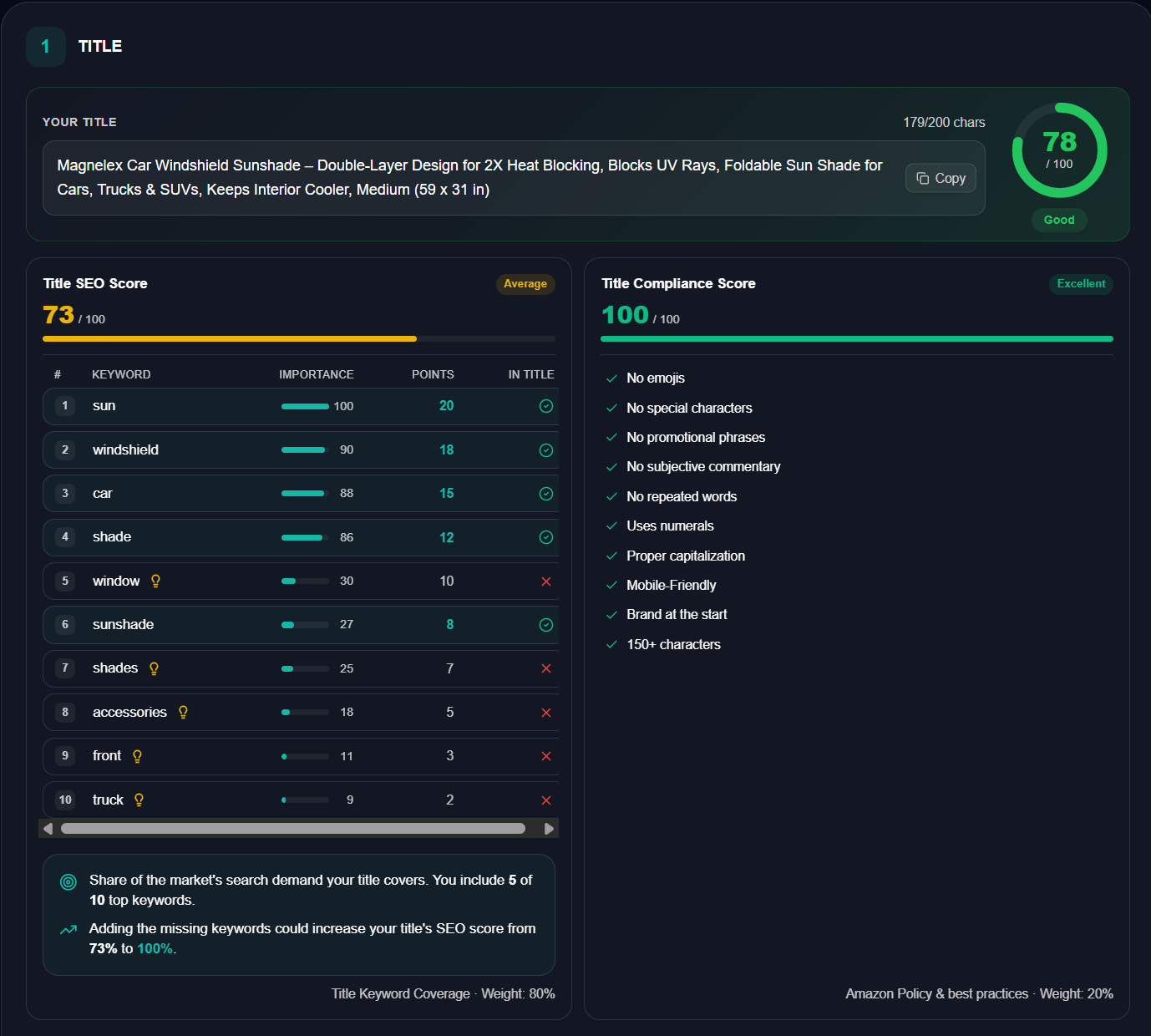
The title card has three parts: your current title, the score breakdown, and (where useful) a suggested rewrite.
What you have
- YOUR TITLE — the listing's current title, character count out of 200, and a Copy button.
- If the title couldn't be read: "Title could not be read for this listing." The rest of the card is skipped.
Title SEO Score (80% of the section)
Scored on top-10 keyword coverage. The tool takes the highest-value generic words from the market keyword universe, weights them by rank (top word = 20 points, tenth = 2 points), and awards points for each one your title actually contains. A perfect 100 means the title covers all ten top keywords.
The keyword table below the score shows:
| # | Keyword | Importance | Points | In Title |
|---|
Each row tells you whether the keyword is present, how much it's worth, and how much including it would move the score. A summary line highlights the gap:
"Share of the market's search demand your title covers. You include N of M top keywords."
If there's headroom, you'll also see the improvement estimate:
"Adding the missing keywords could increase your title's SEO score from X% to Y%."
If the SEO score is already 90+, that whole rewrite step is skipped and you get an "already excellent" confirmation instead.
Title Compliance (20% of the section)
A checklist of Amazon best practices and hard policy rules — things like no emoji, no promotional language, no special characters, no subjective claims, no excessive repetition, mobile-friendly first ~75 characters, brand-first, keeping length under 150 characters, and so on. Every failed row is a Violation in the summary tally; every passed row is a Strength.
Suggested Title
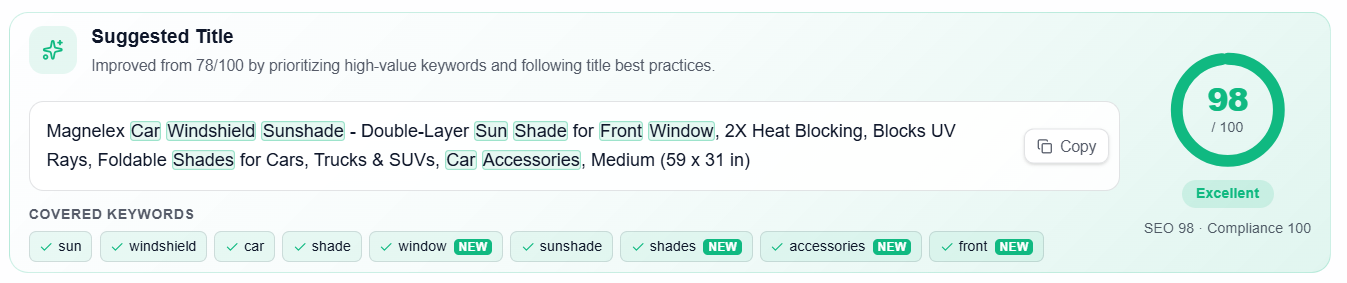
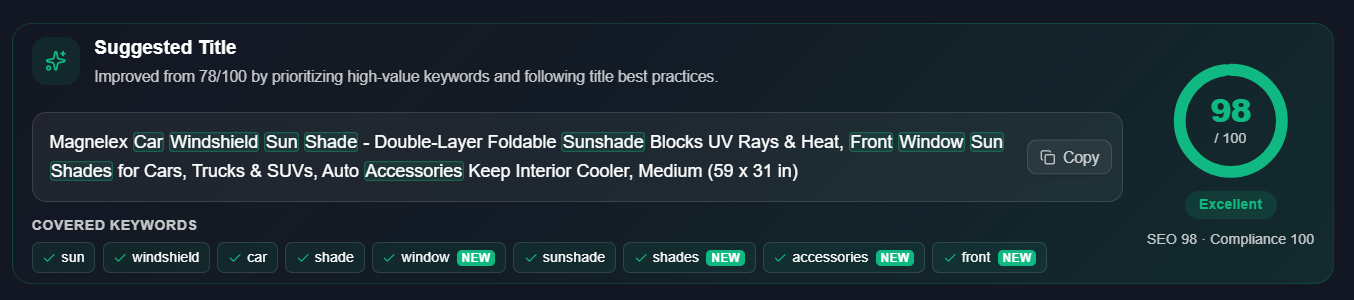
When the current title is below Excellent, a rewrite appears with:
- The new title text.
- A Copy button.
- A one-line explanation: "Improved from N/100 by prioritizing high-value keywords and following title best practices."
- Covered Keywords chips — the top keywords the new title now includes; brand-new keywords (not in the old title) carry a NEW badge.
The suggestion respects both axes — it packs missing keywords in and passes the compliance checks. Compliance-critical patterns won't be introduced just to hit the SEO number.
Bullet Points
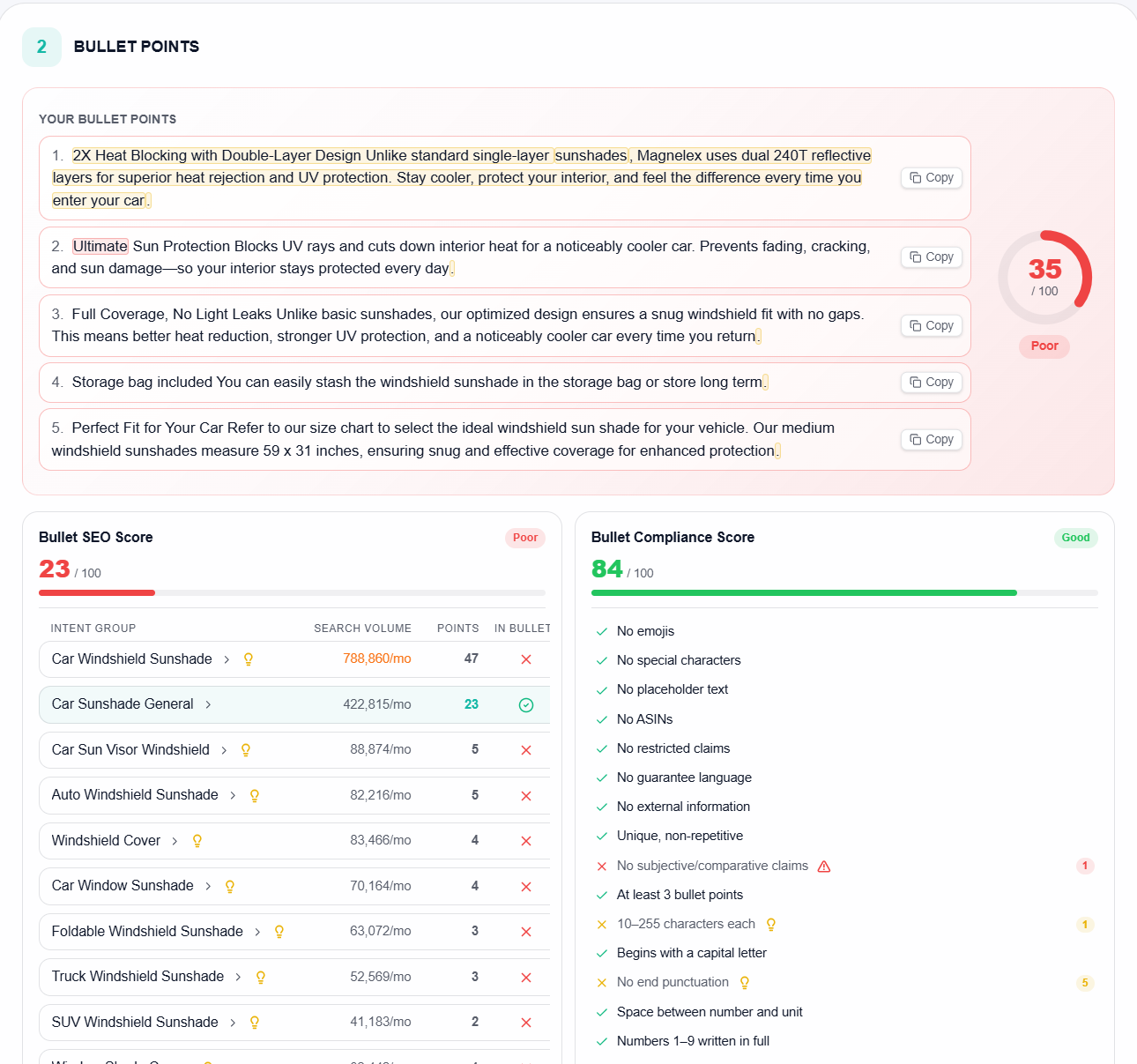
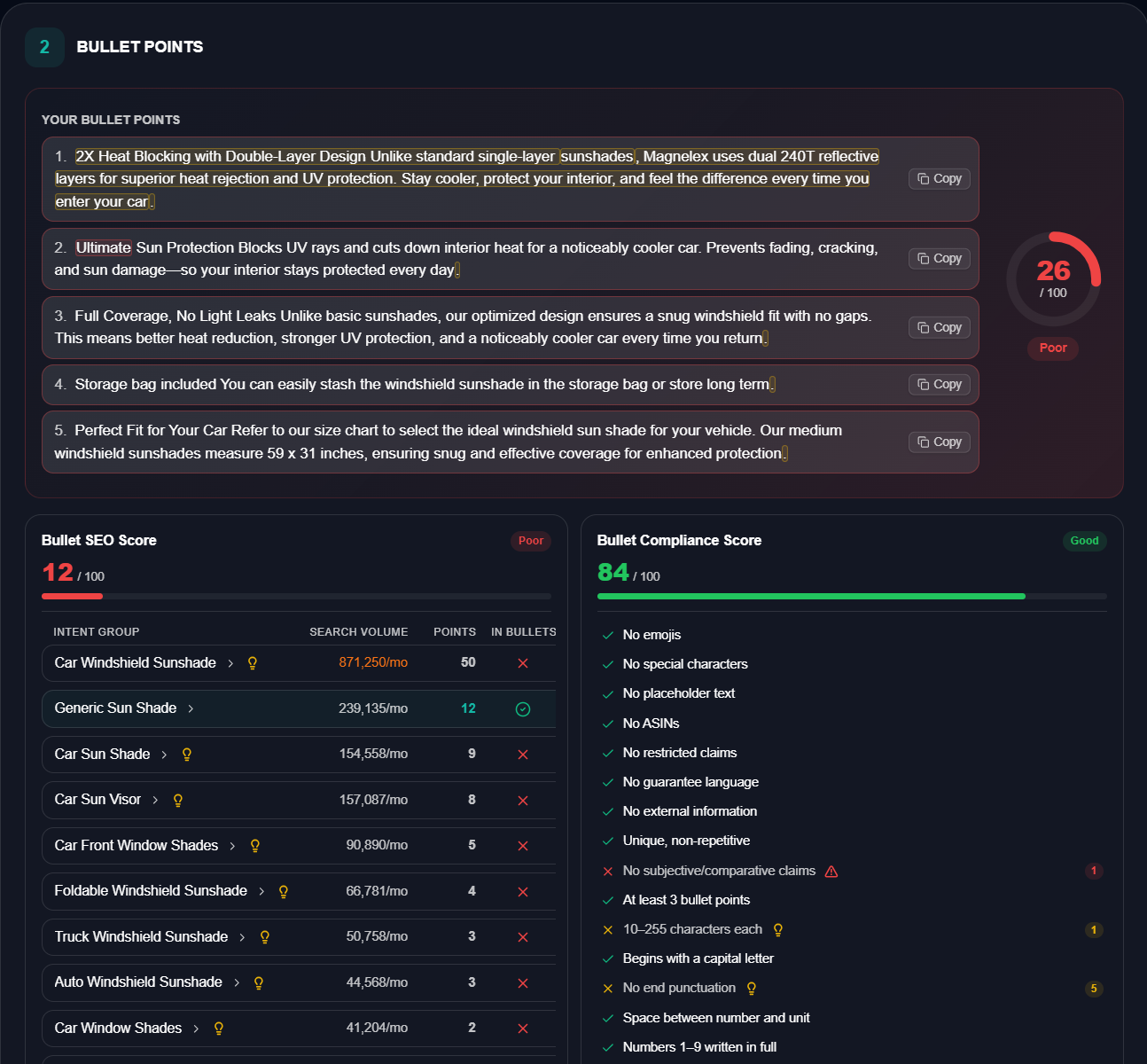
The bullets card mirrors the title card structure but scores against search intent groups, not raw keywords.
What you have
- YOUR BULLET POINTS — the listing's current bullets. Empty listings show "No bullet points found for this listing."
- Copy on each bullet.
Bullet SEO Score (80% of the section)
Scored on intent volume coverage. The keyword universe is clustered into 8–20 shopper intents (e.g. "non-slip yoga mat", "eco-friendly mat", "large yoga mat"). Each intent has a search volume. The tool measures how much of that combined weighted demand your bullets cover — where a bullet "covers" an intent if it mentions the intent's keywords in any order (loose phrase matching).
The intent table shows:
| Intent Group | Search Volume | Points | In Bullets |
|---|
Expandable rows drill into which keywords make up each intent. The summary lines follow the same format as the title:
"Share of the market's search demand your bullet points cover. You cover N of M market intents."
"Adding the missing intents could increase your searchable demand coverage from X% to Y%."
Off-target intents (searches that look related but aren't a fit for your product) are excluded so you don't spend bullet real estate on the wrong shoppers.
Bullet Compliance (20% of the section)
Fifteen checks covering things like no emoji, no promotional or subjective language, no ASINs referenced in copy, no unverified claims or guarantees, no external links, no excessive repetition, minimum three bullets, 10–255 character bullets, capitalization consistency, no end punctuation, number spacing, spelling out digits 1–9. Each failed row is a Violation.
Suggested Bullet Points
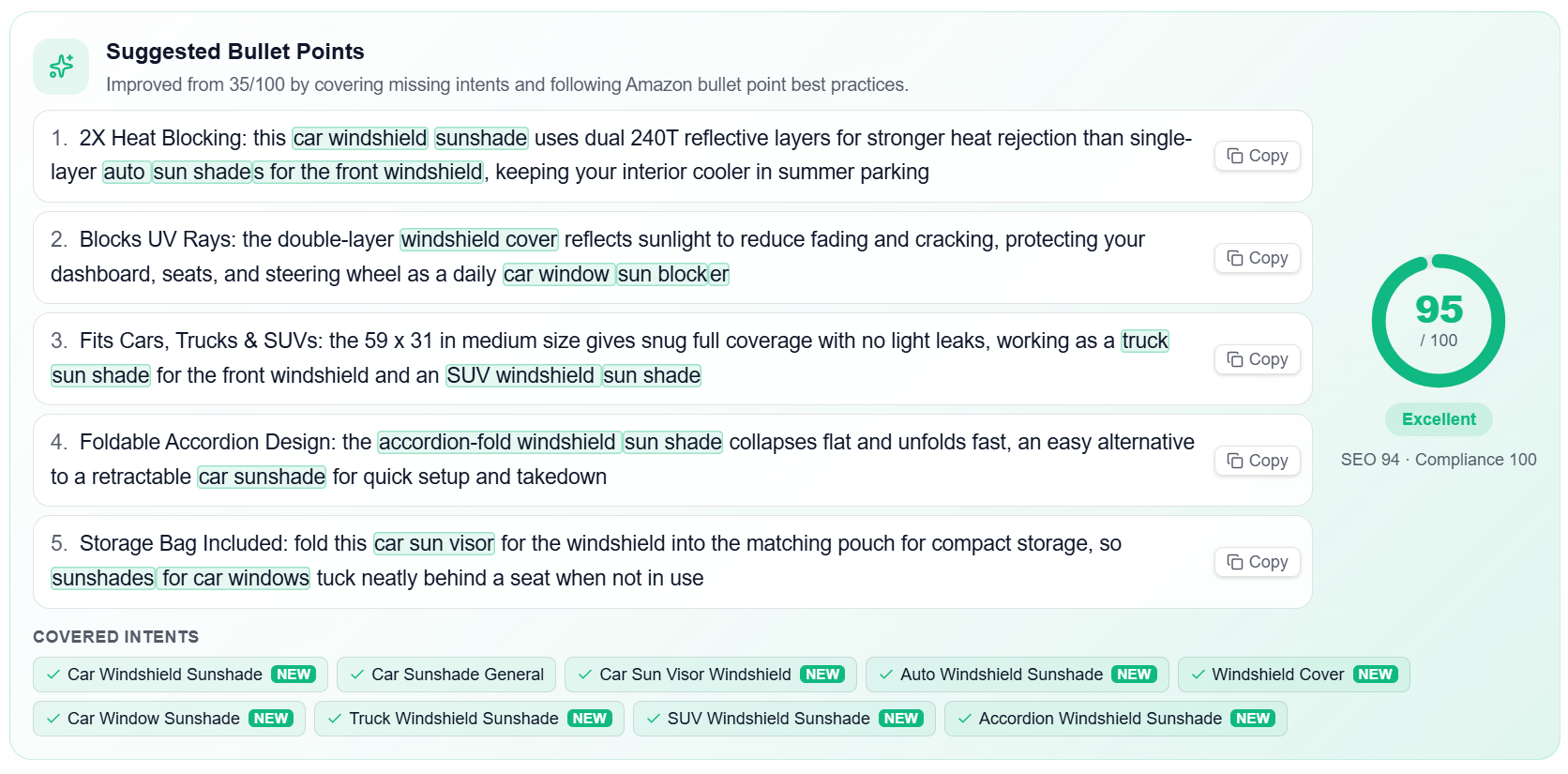
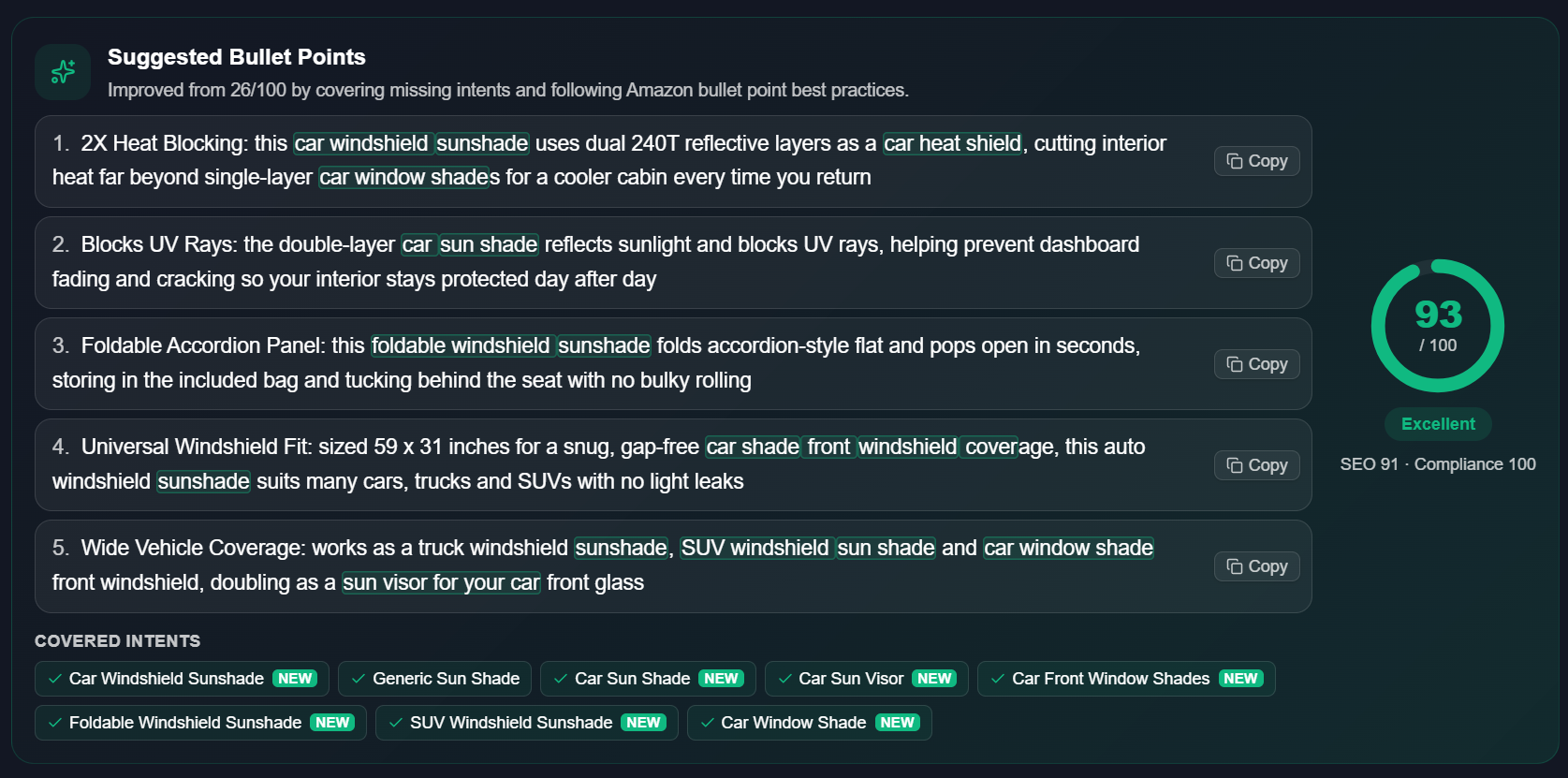
When the current bullets are below Excellent, a rewrite appears:
- Up to five new bullet points, one per line.
- Copy on each new bullet.
- A one-line explanation of what changed.
- Covered Intents chips — the intents the new bullets now cover, with NEW badges for anything the old bullets missed.
The rewrite targets an SEO score of 90+ and clears the compliance checklist. If neither is currently below Excellent, no rewrite is offered.
Reading the two scores together
- High SEO / low Compliance — the listing ranks for the right terms but is a suppression risk. Prioritise the compliance fixes first.
- Low SEO / high Compliance — the listing is clean but invisible. The keyword and intent gaps in the tables are where to focus.
- Low on both — the suggested rewrites are usually the fastest route; apply them and re-analyse.
- High on both (90+) — you'll see "already excellent" confirmations. Don't touch it; move to images or A+.